
Jim Hogg County Criminal Court Cases
Jim Hogg County uses three local court levels rather than a municipal court layer. The 229th Judicial District Court hears felony criminal cases in the second-floor courtroom at the Jim Hogg County Courthouse, 102 E. Tilley Street in Hebbronville. It is part of a three-county judicial district. The constitutional County Court hears Class A and Class B misdemeanor cases and appeals from fine-only justice matters. Four justice precincts share the counter at 133 E. David Street for Class C misdemeanors, citations, magistration, and capias work. Jim Hogg County has no incorporated municipality, so no city municipal court keeps another set of criminal files.
The combined County and District Clerk is the custodian for the filed district and county case records. That shared office does not erase the division between courts. Rae Gutierrez is identified for district criminal matters, while Kathy Morales handles county cases. A request should name the correct court and give the cause number when known. The file may show a filed charge that differs from the charge recorded at arrest because the prosecutor makes a later filing decision.
Jim Hogg County Court Map
Choosing the right desk is the first useful filter. Felony accusations are presented in the district system, where the 229th Judicial District Attorney handles prosecution. Ordinary county misdemeanors move through County Court with the County Attorney. Fine-only cases stay with a justice precinct unless appealed. The official Texas county-court directory verifies the County Court's criminal jurisdiction, while the local court and clerk pages identify the people who route each record request.
The Texas Judicial Branch docket interface supplies a second way to locate Jim Hogg County court settings. The captured state interface below is an index, not the complete clerk file.
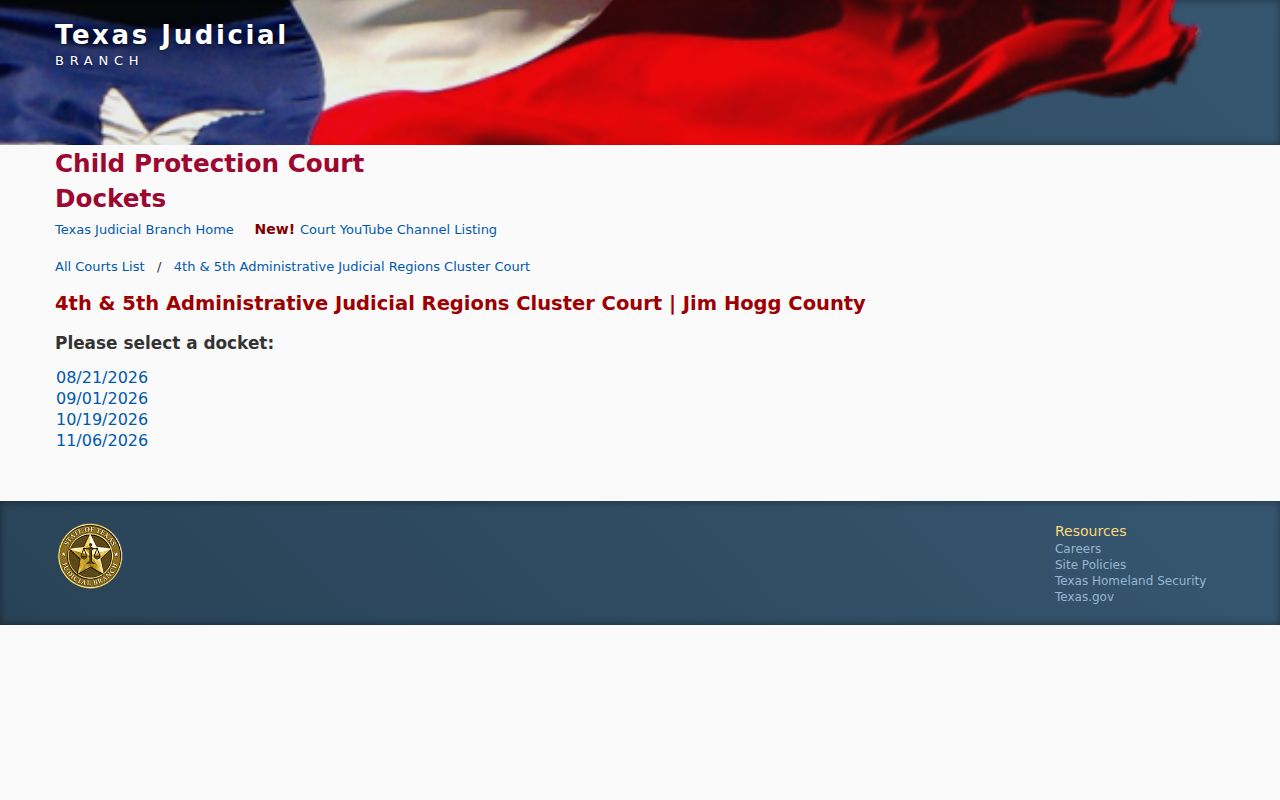
Use a calendar result to identify the court and setting, then ask the Jim Hogg County clerk for the pleadings, orders, and final judgment that establish what happened.
Searching Jim Hogg County Case Records
No single free name search covers all Jim Hogg County criminal case records. The county district page publishes dated docket PDFs, not a party-name database. re:SearchTX is tied to eFileTexas and can supplement local work, but public roles, participating courts, available documents, and charges vary. The combined clerk remains the authoritative source when a portal is incomplete or access is restricted.
- Choose the likely court level from the charge: district felony, County Court misdemeanor, or justice-court fine-only matter.
- Open the 229th District Court page, expand the right year, and inspect dated Criminal Docket, Civil/Criminal Docket, or Trial Docket PDFs.
- Write down the cause number, court, setting date, case style, and event label from any matching calendar row.
- Call the combined clerk at (361) 527-4031 and request the public docket sheet, charging instrument, orders, judgment, sentence, and cost ledger.
- Ask whether electronic or paper copies are available and obtain a quote for search, copy, certification, and mailing charges before ordering.
The local docket archive exposes only a few controls, while re:SearchTX adds a registered statewide layer. The absence of a county name box is itself an important search fact:
| Field Label | Type | Required | Notes |
|---|---|---|---|
| Calendar year | Accordion | Yes for county archive | Expands the available docket links for that year |
| Docket date and type | PDF link | Yes for county archive | Opens Criminal, Civil/Criminal, or Trial Docket |
| Party name | Search field | Unavailable locally | The county archive has no party-name query |
| Cause number | Search field | Unavailable locally | Read it in a PDF or give it to the clerk |
| re:SearchTX registration | Account access | Yes | Coverage, public role, documents, and charges vary |
Note: The Jim Hogg Official Records Search indexes property instruments and will not return a criminal court case file.
Jim Hogg Criminal Docket PDFs
The local archive posts court calendars from 2021 through 2026. Each PDF is a snapshot for a scheduled date, not a complete history. A sample row can show the court and judge heading, county, docket time, jail or non-jail group, case style, abbreviated charge, lawyers, notes, and a cause number in a form such as YY-CRJ-NN. Settings observed in the official files include arraignment, bond-reduction motions, entry of DCO, motions to adjudicate guilt, Veterans Program status, early termination, revocation, and failure to appear.
A calendar leaves out facts many readers need. It does not show date of birth, SID, home address, a full filing history, statute citation, offense degree, bond amount, all motions, final disposition, sentence, ledger, or downloadable pleadings. The event label describes why the case was set. It does not prove how the judge ruled. That limit is why Jim Hogg County criminal case research should move from the PDF to the clerk's docket sheet and signed order.
Note: A docket entry marked for adjudication, revocation, or early termination records a setting, not the court's final decision.
Inside a Jim Hogg County Case File
The complete file joins the accusation to the result. Ask for the public case index or docket sheet first because it lists activity in date order. Then select the charging paper, bond orders, motions, signed orders, judgment, sentence, and itemized costs that answer the specific question. A district felony may begin with an indictment. A county misdemeanor is commonly filed by complaint and information. Later papers can reflect an amended, reduced, dismissed, or otherwise changed charge.
| Cause Number & Court | Identifies the local file and the district, county, or justice court responsible for it. |
|---|---|
| Charging Document | States the accusation the prosecutor filed, which may differ from the initial arrest charge. |
| Docket Entries | List filed papers, settings, motions, and orders in procedural sequence. |
| Hearing Dates | Show arraignment, pretrial, plea, trial, bond, revocation, or later settings. |
| Disposition & Judgment | Record dismissal, plea, verdict, deferred adjudication, or other result in the signed court record. |
| Sentence & Conditions | Set out confinement, fine, costs, and community-supervision terms when imposed. |
A Jim Hogg County judgment is stronger proof of disposition than an isolated docket label or DPS name match. Certified copies may be needed when the authenticity of the clerk's record matters. No local fee schedule is posted, so the clerk must quote copy, certification, mailing, and search charges.
Reading Jim Hogg Criminal Cause Numbers
The local district calendar uses a visible pattern such as YY-CRJ-NN, but the published page does not provide a code key. Use the full string as printed. Do not drop leading zeros or replace the separators when giving it to the clerk. A cause number is a file locator, not a summary of guilt, offense degree, or outcome.
Calendar terms also need care. Arraignment is the stage when the accused hears the filed charge and enters a plea. A motion to adjudicate asks the court to enter guilt after deferred adjudication. A motion to revoke concerns alleged violations of community supervision. DCO is an abbreviated local docket term, so the underlying filed paper or signed order should be requested instead of guessing what the shorthand means in a specific case.
How a Criminal Case Moves
After arrest and Article 15.17 magistration, the charging path depends on case level. A prosecutor may file a complaint and information for a misdemeanor or present a felony to a grand jury. An indictment is the formal felony accusation. Arraignment and pretrial settings follow. The matter can end through dismissal, plea, or trial, and the judge enters the judgment and sentence. Later Jim Hogg County court records may concern bond, adjudication, revocation, or early termination rather than the original guilt decision.
Case flow: Charges Filed → Arraignment → Pretrial → Plea or Trial → Disposition → Sentencing
The sequence explains why a recent arrest may have no clerk file yet and why the filed charge can change. It also shows why a calendar row cannot replace the final signed judgment.
Jim Hogg Prosecutors and Court Charges
Prosecutor records and clerk records overlap but are not the same. The Jim Hogg County department directory identifies 229th Judicial District Attorney Gocha A. Ramirez, who handles felony prosecution from Suite 206 in the courthouse. County Attorney Rodolfo V. Gutierrez handles the ordinary misdemeanor layer. Their filing decision creates the court charge, while the clerk preserves what was filed and each order the judge entered. A sheriff booking sheet instead preserves the initial custody and arrest data.
When reviewing your own Jim Hogg County case, compare the arrest label, charging paper, and judgment as three distinct steps. A charge may be declined, amended, enhanced, reduced, dismissed, or resolved under a different description. If a state criminal-history entry has the wrong result, obtain certified disposition proof from the clerk before asking the reporting agency or Texas DPS to correct its data.
Jim Hogg Court Levels by Charge
Texas Penal Code Chapter 12 supplies the ordinary punishment classes, but offense-specific rules and enhancements can change the range. The official Texas punishment chapter places capital through state-jail felonies at the district level in Jim Hogg County. Class A and B misdemeanors belong in County Court. Class C cases are fine-only matters handled by the justice courts because the county has no municipal court.
The captured Penal Code Chapter 12 table below is the official source for offense-level ranges used to route Jim Hogg County criminal court cases.
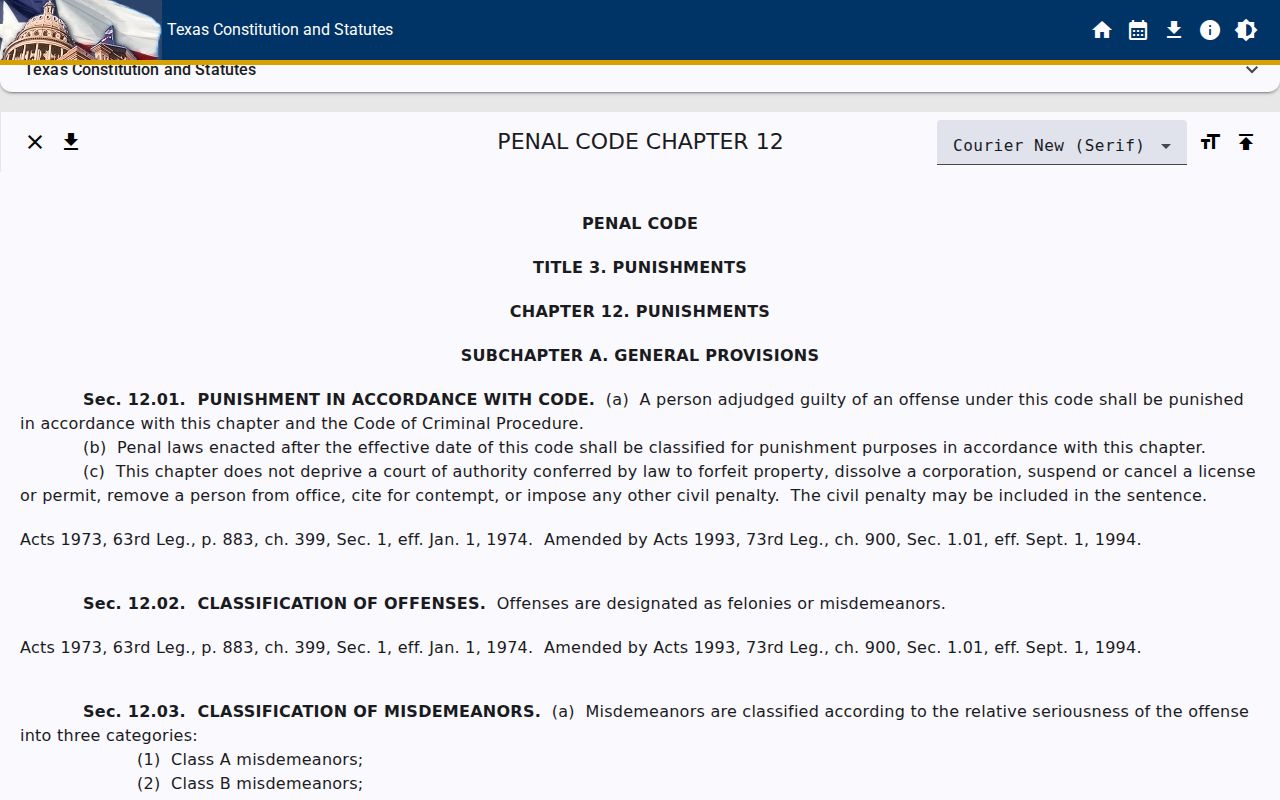
Read the filed charge and judgment together. A short docket description does not reveal enhancements, the exact statute, or the sentence the court imposed.
Jim Hogg Certified Court Records
The County and District Clerk serves the public Monday through Friday, 9 a.m. to noon and 1 p.m. to 5 p.m., except holidays, at 102 E. Tilley Street. The noon closure is worth planning around in this rural county. The office telephone is (361) 527-4031, and its mailing address is P.O. Box 878, Hebbronville, TX 78361. Ask which staff member handles the case level before sending a request.
State whether an uncertified electronic copy is enough or whether a certified paper judgment is required. Include the cause number, defendant name, court, and approximate year. Specify each paper wanted. Since Jim Hogg County posts no court-copy fee sheet, ask for a written quote that separates search, copy, certification, and mailing costs. A narrow order is easier to price and less likely to return pages that do not answer the question.
Case Record Access & Restrictions
Court access does not mean every page is open. Judicial records rules, clerk duties, court orders, and document-specific law govern criminal case files. Juvenile material, protected victim facts, sealed papers, expunged records, and information covered by a nondisclosure order may be withheld or redacted. When one pleading is restricted, ask whether the public docket sheet, indictment or information, and judgment remain available.
The Texas Public Information Act applies to public information held by government bodies, but court files should not be treated as if every paper follows the same agency-request process. Texas Government Code Chapter 411 separately limits criminal-history dissemination. Current expunction law sits in Code of Criminal Procedure Chapter 55A, effective January 1, 2025. Nondisclosure under Chapter 411 restricts public release but does not destroy every government record.
The official Chapter 55A law page shown below helps distinguish current law from older summaries that still cite former Chapter 55.
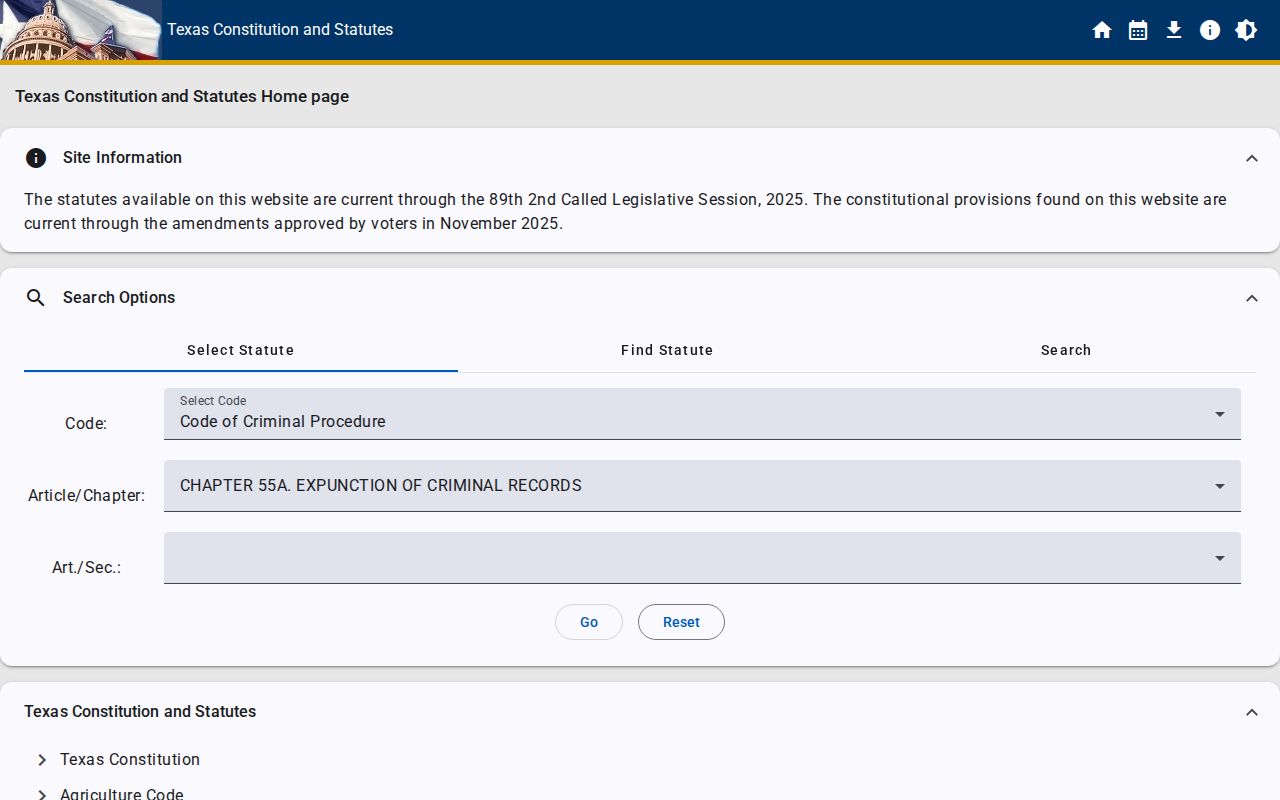
Do not infer that a dismissal erased the case. Eligibility depends on the full arrest episode, waiting rules, related charges, and other statutory conditions.
Federal Cases Beyond Jim Hogg County
A federal prosecution is not kept by the Jim Hogg County clerk. Jim Hogg County lies in the Laredo Division of the U.S. District Court for the Southern District of Texas. The federal clerk is at the George P. Kazen Federal Building and U.S. Courthouse, 1300 Victoria Street in Laredo, with public hours from 8 a.m. to 5 p.m. Monday through Friday. The clerk's telephone is (956) 723-3542.
PACER provides federal dockets and documents after registration. Through December 31, 2026, the stated fee is $0.10 per page, with a $3 cap for one document or case-specific report and quarterly charges waived at $30 or less. Some searches, non-case reports, and transcripts fall outside those caps. The announced January 1, 2027 schedule raises the per-page fee to $0.12 and the quarterly waiver to $40.
The captured PACER record-access screen is the federal source image for Jim Hogg County court research.
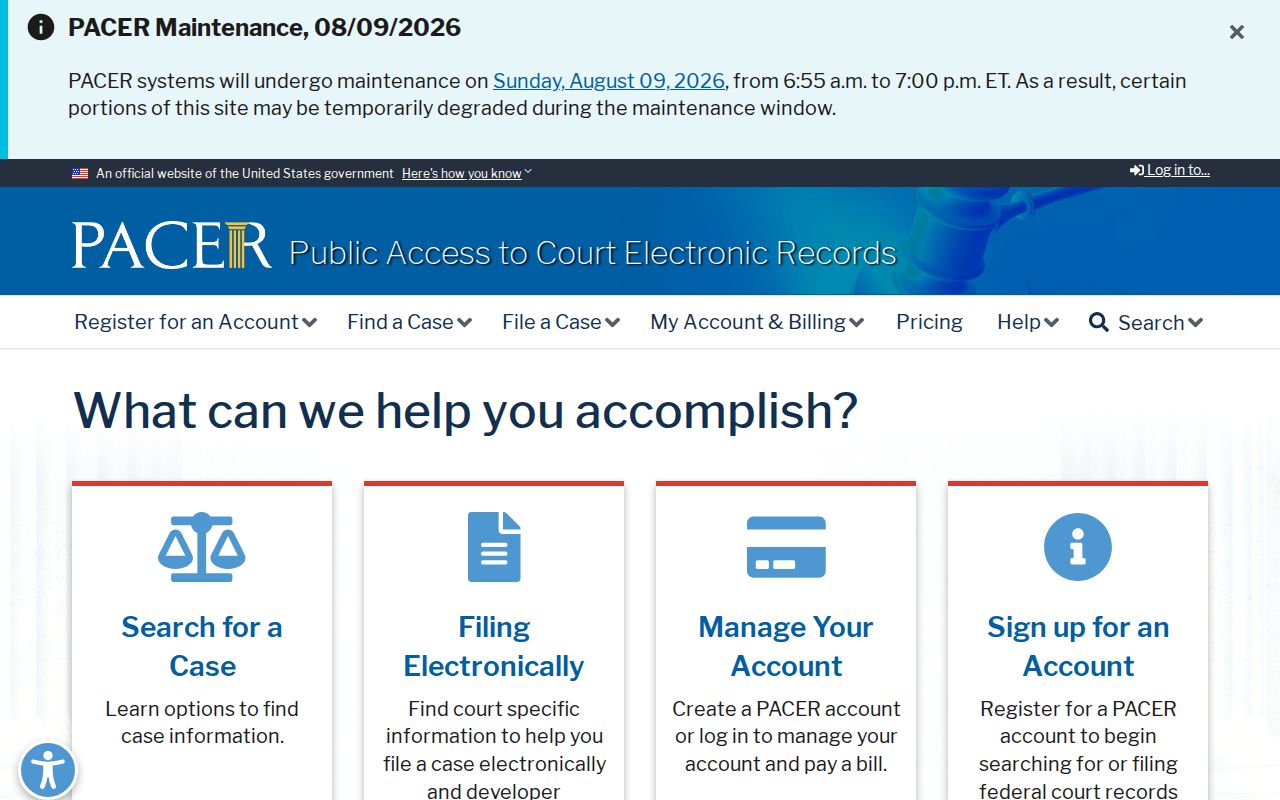
Search PACER for the federal docket, but return to the Jim Hogg County clerk for state district, county, and justice-court files.